
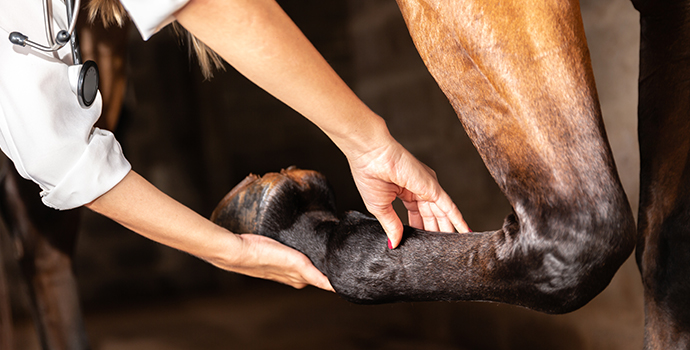
Veterinary Spinal Manipulation Therapy (VSMT), often referred to as “animal chiropractic”, is a holistic treatment modality that has been practiced for over a century. VSMT focuses on the relationship between structure and function of the animal spine. There are hundreds of joints, or motion units, in your animal’s body—including over 200 joint spaces in the equine spine alone! These joints all have a certain range of motion that allows the animal to run, jump, and perform normally. When there is dysfunction of any of these joints it causes subsequent dysfunction of the surrounding muscles, connective tissue, and nerves. This creates a cascade of pain and inflammation that can have varied and widespread effects on animals, including poor performance, unbalanced behavior, and decreased immune function and fertility.
How does VSMT work?
VSMT promotes overall patient health and function by restoring normal joint motion. VSMT is NOT “putting a bone back in place”—the bones that make up a joint are not out of place but simply not moving in relation to one another as they should. When your pet is evaluated for VSMT, the doctor will thoroughly assess the range of motion of each joint in your animal’s body, called motion palpation. From the TMJ to the tail and everything in between, your “animal chiropractor” will then apply a high velocity, low amplitude thrust to any restricted joint in a very specific way that causes a slight, transient gap in the joint. This gap breaks down adhesions (scar tissue) and allows the joint structures to return to normal positioning. At the same time it creates a quick pull of the adjacent muscles, which signals the surrounding nerves to fire messages to the spinal cord and brain. These messages override the previous messages of pain and stress that the body is experiencing.
What animals can benefit from VSMT?
The short answer: all of them! From young puppies to experienced equine athletes, VSMT can be used in animals of all shapes and sizes. Most people seek out chiropractic care for their pets when they feel the pet is in pain or not acting like their normal self. If your horse is experiencing pain, you may notice such signs as tension in the back muscles, difficulty with transitions, reluctance to move forward under saddle, unilateral or bilateral lameness, or abnormal behavior. Dogs and cats can also show signs of pain, including hunching their back, difficulty standing up or laying down, limping, and behavior issues. Your animal doesn’t need to be showing obvious signs of pain to benefit from an adjustment though - chiropractic care is extremely useful as a preventative treatment to notice subtle changes in your animal before they become bigger problems.
What are the risks of VSMT?
Luckily, if you use a veterinarian or chiropractor who was trained at an accredited school of VSMT, there are few risks with an adjustment. The most common side effect of VSMT is mild muscle soreness in the first few days after an adjustment. To prevent more serious, adverse effects, chiropractic care is not indicated for animals that have significant pathology, such as a fracture or full luxation (dislocation), and should never replace a complete workup of lameness or disease by your primary veterinarian.
The risks of VSMT performed by someone who did not successfully complete an accredited training program - such as a lay chiropractor - include bruising, increase in lameness or pain, or paralysis. The courses that are currently accredited in the United States only accept practitioners who have already obtained their Doctorate of Veterinary Medicine or Doctorate of Chiropractic. All programs involve intense training over several months both in the classroom and hands-on with patients, where the doctors greatly expand on their knowledge of anatomy, physiology, and biomechanics and go through rigorous testing to ensure their competency.
Veterinary Spinal Manipulation Therapy (VSMT), often referred to as “animal chiropractic”, is a holistic treatment modality that has been practiced for over a century. VSMT focuses on the relationship between structure and function of the animal spine. There are hundreds of joints, or motion units, in your animal’s body—including over 200 joint spaces in the equine spine alone! These joints all have a certain range of motion that allows the animal to run, jump, and perform normally. When there is dysfunction of any of these joints it causes subsequent dysfunction of the surrounding muscles, connective tissue, and nerves. This creates a cascade of pain and inflammation that can have varied and widespread effects on animals, including poor performance, unbalanced behavior, and decreased immune function and fertility.
How does VSMT work?
VSMT promotes overall patient health and function by restoring normal joint motion. VSMT is NOT “putting a bone back in place”—the bones that make up a joint are not out of place but simply not moving in relation to one another as they should. When your pet is evaluated for VSMT, the doctor will thoroughly assess the range of motion of each joint in your animal’s body, called motion palpation. From the TMJ to the tail and everything in between, your “animal chiropractor” will then apply a high velocity, low amplitude thrust to any restricted joint in a very specific way that causes a slight, transient gap in the joint. This gap breaks down adhesions (scar tissue) and allows the joint structures to return to normal positioning. At the same time it creates a quick pull of the adjacent muscles, which signals the surrounding nerves to fire messages to the spinal cord and brain. These messages override the previous messages of pain and stress that the body is experiencing.
What animals can benefit from VSMT?
The short answer: all of them! From young puppies to experienced equine athletes, VSMT can be used in animals of all shapes and sizes. Most people seek out chiropractic care for their pets when they feel the pet is in pain or not acting like their normal self. If your horse is experiencing pain, you may notice such signs as tension in the back muscles, difficulty with transitions, reluctance to move forward under saddle, unilateral or bilateral lameness, or abnormal behavior. Dogs and cats can also show signs of pain, including hunching their back, difficulty standing up or laying down, limping, and behavior issues. Your animal doesn’t need to be showing obvious signs of pain to benefit from an adjustment though—chiropractic care is extremely useful as a preventative treatment to notice subtle changes in your animal before they become bigger problems.
What are the risks of VSMT?
Luckily, if you use a veterinarian or chiropractor who was trained at an accredited school of VSMT, there are few risks with an adjustment. The most common side effect of VSMT is mild muscle soreness in the first few days after an adjustment. To prevent more serious, adverse effects, chiropractic care is not indicated for animals that have significant pathology, such as a fracture or full luxation (dislocation), and should never replace a complete workup of lameness or disease by your primary veterinarian.
The risks of VSMT performed by someone who did not successfully complete an accredited training program—such as a lay chiropractor—include bruising, increase in lameness or pain, or paralysis. The courses that are currently accredited in the United States only accept practitioners who have already obtained their Doctorate of Veterinary Medicine or Doctorate of Chiropractic. All programs involve intense training over several months both in the classroom and hands-on with patients, where the doctors greatly expand on their knowledge of anatomy, physiology, and biomechanics and go through rigorous testing to ensure their competency.