
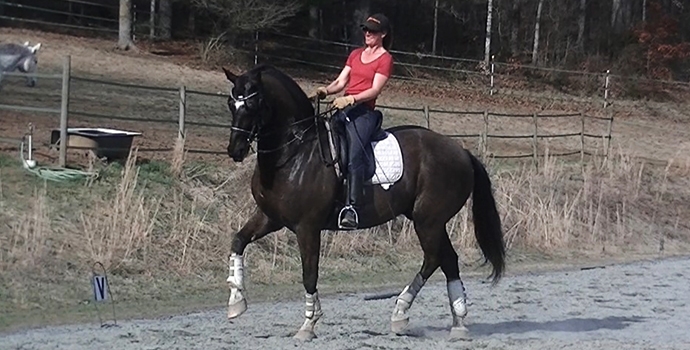
The word dressage often conjures up images of high level collection, fantastic lateral movements, and even airs above the ground. The truth is, dressage is a French word that simply means training. How do equestrians progress from the daily schooling of the basic paces – walk, trot, and canter – to training these advanced maneuvers? Dressage is built on a biomechanical foundation for both the horse and the rider. Understanding how both equine and human bodies work and how they work together is the first step to climbing the levels.
Understanding the horse’s balance
The horse is naturally built on the forehand. At a standstill 3/5 of his weight is on his forehand; forehand meaning in front of the withers. As he moved forward and the faster he goes, more and more weight shifts onto his forehand. In dressage, we want to shift the horse’s center of gravity off his forehand towards his haunches. We accomplish this by getting him to engage his hind legs, lift his back, and carry his head and neck out and down toward the bit.
To see how the horse’s muscles work together to accomplish this carriage, let’s take a look at the lovely diagram from the book “The Rider Forms the Horse” by Udo Burger and Otto Zietzschmann in the link below. Here, the horse’s topline muscles are separated into three large groups – the neck muscles in blue, the back muscles in green, and the muscles of the haunches in red. Mainly notice how the long back muscle is attached to the large gluteal muscle at one end and to various muscles of the neck at the other. Now imagine how the large gluteal muscle rotates and pulls on the far end of the long back muscle as the horse reaches his hind leg forward under his body. Secondly, imagine how the various neck muscles bow and lengthen as the horse stretches his neck out and down toward the bit, pulling on the close end of the long back muscle. Because of the way the horse’s muscles attach to one another, when he reaches that hind leg far under his body at the same time as he seeks the bit, the long back muscle is engaged supplely upward.
The quality of back engagement depends on how well the horse is using his hind end and how softly seeking the bit he is in front. Tension and hesitation in his hind or front end will manifest in his back as well and cause it to stiffen and/or drop. Tension in his back will prevent the energy from flowing from his hind, through his body, and out into the rider’s hand.
Visual Aid: https://youtu.be/vyNPDQz-cj8
Understanding the rider’s balance
As riders, we strive to align our center of gravity with our horse’s. The more “with the horse” we can stay, the safer and smoother the ride and the less we impede our horse’s natural beauty and movement. The jockey, wishing to stay with her very forward-balanced race horse at a full gallop, rides in a very forward seat with short stirrups. The dressage rider, on her more centered-balanced horse, rides with longer stirrups, an erect torso, and centered or neutral pelvis. These qualities support a more centered balance for the rider and thus her horse as well.
So what does a centered or neutral pelvis mean? It means that your pelvis is aligned directly under your spine, not tilted forward or backward. This allows your torso to sit comfortably erect on top. The weight of your torso lands evenly on both seat bones in the saddle, and your legs hang naturally straight down from each hip bone. Stacking body parts in this way, combined with positive muscle engagement, holds the rider’s balance steady in the center of the horse, safe-guarding you from falling forward in front of your horse’s motion, or backward behind it.
Positive muscle engagement or tone means holding the amount of muscle tension required to maintain balance in motion, no more no less, while keeping the joints between the muscles supple and flexible. The main place most riders struggle to maintain positive muscle engagement is in their core. Our goal is to hold positive muscle tone through our lower back and abdomen while keeping our center of gravity low, as close to the saddle as possible, all while breathing rhythmically and deeply. Deep, rhythmical breathing is largely responsible for maintaining the suppleness required of an effective rider. Sound like a lot? Try this exercise and you can accomplish all three at once and refer back to it later when we discuss half halts. In fact, this exercise provides a good “rider’s half halt.”
My #1 rule for any breathing exercise is that you should not get dizzy. If you feel dizzy during this exercise, immediately resume your normal breathing pattern. When you try the exercise again, do so in your normal breathing rhythm, trying not to make your inhales or exhales longer or shorter than normal. Begin by sitting. Center your pelvis, straighten your torso, roll your shoulders back and then release them to hang back and down. As you breathe in, feel the breathe filling your torso like water fills a glass. Fill the very bottom (pit) of your belly first and continue to inhale until the air fills in your chest, up your throat, and spills out your mouth. Now exhale as if a plunger were pushing the air out of your torso, compressing it down into the pit of your belly as it leaves first your throat, then chest, and lastly the very bottom of your belly. Repeat three to six times. You should feel not only that you are getting full, deep breathes of air, but also your center of gravity sinking down into the pit of your belly.
The breathing exercise positively engages your lower back and abdominal (core) muscles, lowers your center of gravity, and helps your seat maintain a constant, steady connection with your horse’s back. If you have trouble breathing while engaging your core, you are likely holding the muscles too strongly. If you have a hard time keeping your seat “glued” to the saddle, you are likely not maintaining enough core engagement to keep your center of gravity pushed down into the saddle.
Practice this posture and breathing exercise several times unmounted. Make a routine of it each time you mount your horse in order to improve your own positive muscle engagement and help you to be more effective in asking your horse to improve his. While you are riding, allow space for awareness of the biomechanics of both yourself and your horse and how your bodies interact.
Works Cited:
Burger, Udo, and Otto Zietzschmann. The Rider Forms the Horse. FNverlag, 1987.
Benedik, Linda. Longeing the Rider for a Perfect Seat. Trafalgar Square, 2007.
Next time: Understanding aiding –science and art interwoven
The word dressage often conjures up images of high level collection, fantastic lateral movements, and even airs above the ground. The truth is, dressage is a French word that simply means training. How do equestrians progress from the daily schooling of the basic paces—walk, trot, and canter—to training these advanced maneuvers? Dressage is built on a biomechanical foundation for both the horse and the rider. Understanding how both equine and human bodies work and how they work together is the first step to climbing the levels.
Understanding the horse’s balance
The horse is naturally built on the forehand. At a standstill 3/5 of his weight is on his forehand; forehand meaning in front of the withers. As he moved forward and the faster he goes, more and more weight shifts onto his forehand. In dressage, we want to shift the horse’s center of gravity off his forehand towards his haunches. We accomplish this by getting him to engage his hind legs, lift his back, and carry his head and neck out and down toward the bit.
To see how the horse’s muscles work together to accomplish this carriage, let’s take a look at the lovely diagram from the book “The Rider Forms the Horse” by Udo Burger and Otto Zietzschmann in the link below. Here, the horse’s topline muscles are separated into three large groups—the neck muscles in blue, the back muscles in green, and the muscles of the haunches in red. Mainly notice how the long back muscle is attached to the large gluteal muscle at one end and to various muscles of the neck at the other. Now imagine how the large gluteal muscle rotates and pulls on the far end of the long back muscle as the horse reaches his hind leg forward under his body. Secondly, imagine how the various neck muscles bow and lengthen as the horse stretches his neck out and down toward the bit, pulling on the close end of the long back muscle. Because of the way the horse’s muscles attach to one another, when he reaches that hind leg far under his body at the same time as he seeks the bit, the long back muscle is engaged supplely upward.
The quality of back engagement depends on how well the horse is using his hind end and how softly seeking the bit he is in front. Tension and hesitation in his hind or front end will manifest in his back as well and cause it to stiffen and/or drop. Tension in his back will prevent the energy from flowing from his hind, through his body, and out into the rider’s hand.
Visual Aid: https://youtu.be/vyNPDQz-cj8
Understanding the rider’s balance
As riders, we strive to align our center of gravity with our horse’s. The more “with the horse” we can stay, the safer and smoother the ride and the less we impede our horse’s natural beauty and movement. The jockey, wishing to stay with her very forward-balanced race horse at a full gallop, rides in a very forward seat with short stirrups. The dressage rider, on her more centered-balanced horse, rides with longer stirrups, an erect torso, and centered or neutral pelvis. These qualities support a more centered balance for the rider and thus her horse as well.
So what does a centered or neutral pelvis mean? It means that your pelvis is aligned directly under your spine, not tilted forward or backward. This allows your torso to sit comfortably erect on top. The weight of your torso lands evenly on both seat bones in the saddle, and your legs hang naturally straight down from each hip bone. Stacking body parts in this way, combined with positive muscle engagement, holds the rider’s balance steady in the center of the horse, safe-guarding you from falling forward in front of your horse’s motion, or backward behind it.
Positive muscle engagement or tone means holding the amount of muscle tension required to maintain balance in motion, no more no less, while keeping the joints between the muscles supple and flexible. The main place most riders struggle to maintain positive muscle engagement is in their core. Our goal is to hold positive muscle tone through our lower back and abdomen while keeping our center of gravity low, as close to the saddle as possible, all while breathing rhythmically and deeply. Deep, rhythmical breathing is largely responsible for maintaining the suppleness required of an effective rider. Sound like a lot? Try this exercise and you can accomplish all three at once and refer back to it later when we discuss half halts. In fact, this exercise provides a good “rider’s half halt.”
My #1 rule for any breathing exercise is that you should not get dizzy. If you feel dizzy during this exercise, immediately resume your normal breathing pattern. When you try the exercise again, do so in your normal breathing rhythm, trying not to make your inhales or exhales longer or shorter than normal. Begin by sitting. Center your pelvis, straighten your torso, roll your shoulders back and then release them to hang back and down. As you breathe in, feel the breathe filling your torso like water fills a glass. Fill the very bottom (pit) of your belly first and continue to inhale until the air fills in your chest, up your throat, and spills out your mouth. Now exhale as if a plunger were pushing the air out of your torso, compressing it down into the pit of your belly as it leaves first your throat, then chest, and lastly the very bottom of your belly. Repeat three to six times. You should feel not only that you are getting full, deep breathes of air, but also your center of gravity sinking down into the pit of your belly.
The breathing exercise positively engages your lower back and abdominal (core) muscles, lowers your center of gravity, and helps your seat maintain a constant, steady connection with your horse’s back. If you have trouble breathing while engaging your core, you are likely holding the muscles too strongly. If you have a hard time keeping your seat “glued” to the saddle, you are likely not maintaining enough core engagement to keep your center of gravity pushed down into the saddle.
Practice this posture and breathing exercise several times unmounted. Make a routine of it each time you mount your horse in order to improve your own positive muscle engagement and help you to be more effective in asking your horse to improve his. While you are riding, allow space for awareness of the biomechanics of both yourself and your horse and how your bodies interact.
Works Cited:
Burger, Udo, and Otto Zietzschmann. The Rider Forms the Horse. FNverlag, 1987.
Benedik, Linda. Longeing the Rider for a Perfect Seat. Trafalgar Square, 2007.
Next time: Understanding aiding–science and art interwoven